Basra University for Oil and Gas and the Chinese oil company ZPEC discuss mutual cooperation.
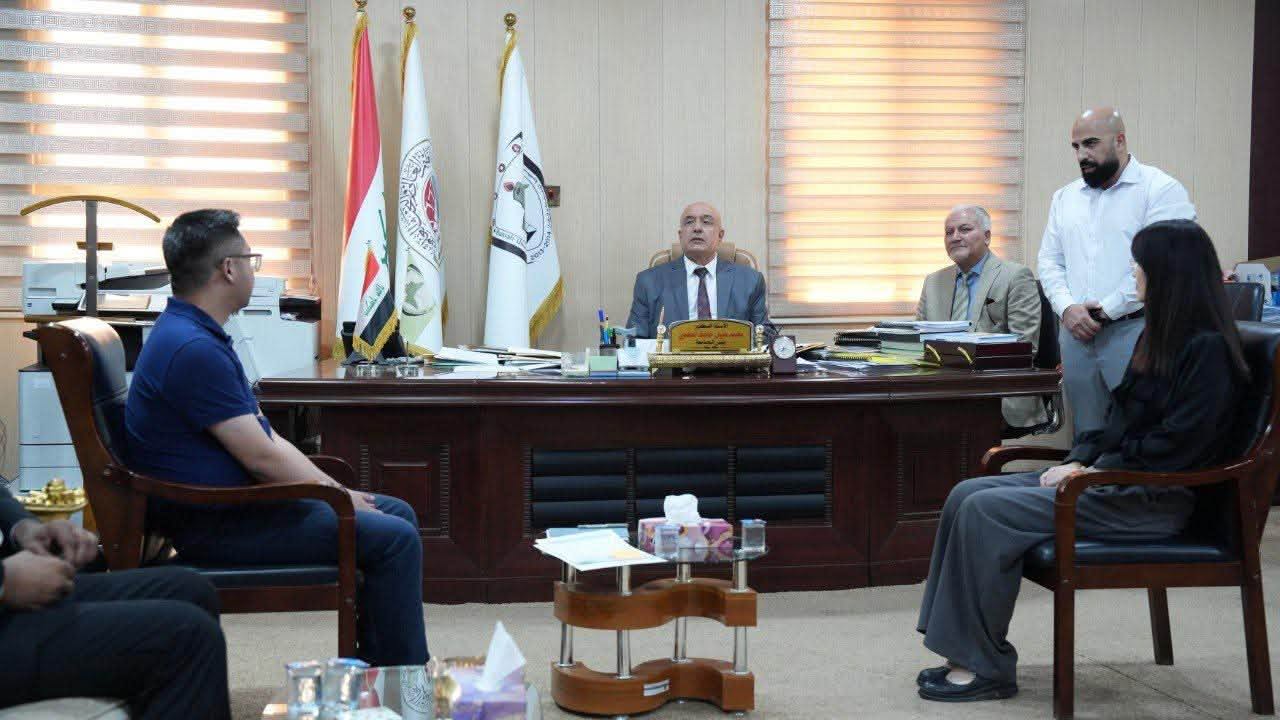
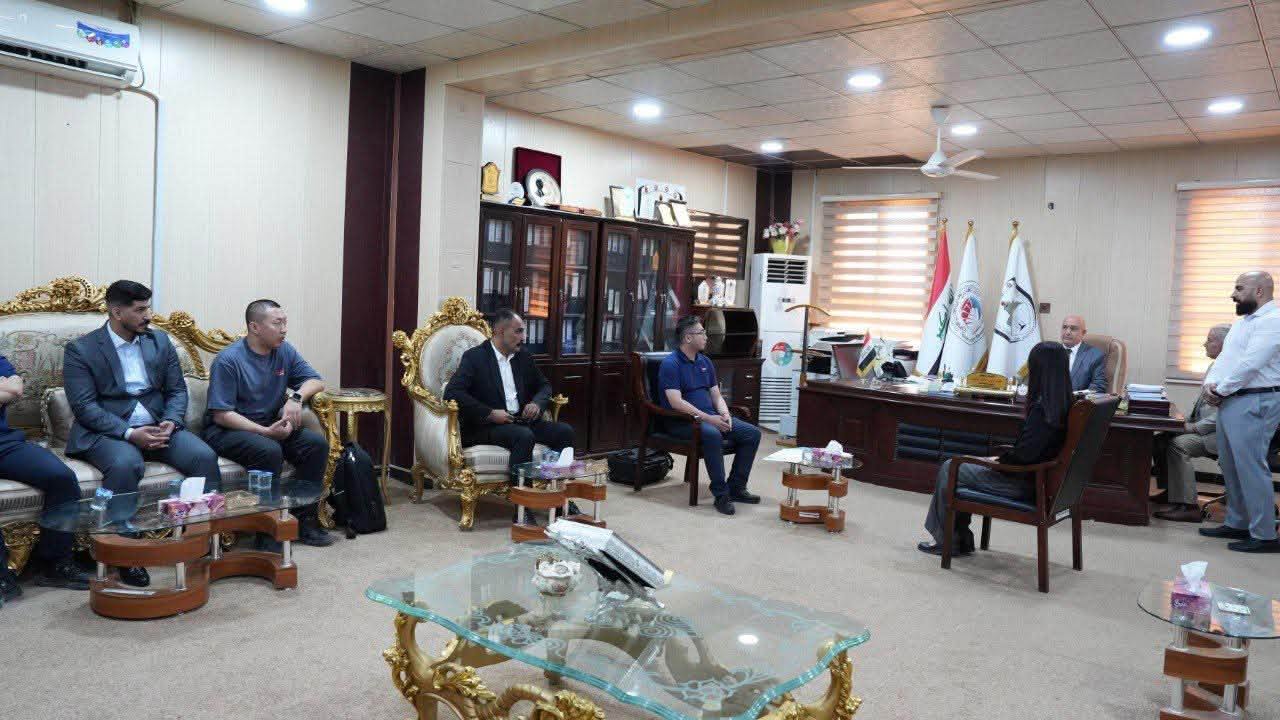
The Chinese oil company ZPEC discussed mutual scientific cooperation with the University of Basra for Oil and Gas. This came during a visit by a delegation from the Chinese company to the University of Basra for Oil and Gas on Sunday morning, September 20, 2026, where the President of the University of Basra for Oil and Gas, Professor Dr. Muhammad Halil Hafez Al-Kaabi, welcomed the company's delegation after conducting interviews with 50 male and female students for the purpose of evaluation and selecting those who passed the interviews for the purpose of training and work in the Chinese company.
The two sides discussed ways of mutual scientific cooperation, and Al-Kaabi appreciated during the meeting the efforts of the Chinese company in conducting job interviews for graduates of the College of Oil and Gas Engineering for the academic year 2025-2026. The meeting began with the following briefing: (Oil, gas and minerals: active resources for the Iraqi economy coupled with the transfer and localization of technology and its development to build extractive and transformative industries).
The University President, Professor Dr. Mohammed Hilal Hafez Al-Kaabi, explained that Iraq faces a dual structural challenge in its contemporary era: the transition from a rentier, one-sided economy entirely dependent on fluctuations in crude oil prices, and the need to meet the demands of technological development in the energy and resource sectors. In this context, our university's vision emerges as an intellectual and scientific framework that seeks to link natural resources with academic knowledge and advanced technological applications. He considers the localization of technology the only way to build a sustainable economic future through the complete investment of resources: from extraction to added value. The economic philosophy of this vision is based on moving beyond the concept of an "oil-producing state that exports raw materials" towards building an integrated industrial environment. Oil, gas, and minerals are not merely commodities for direct sale, but rather essential inputs for high-value manufacturing industries. This also includes investing in associated gas by halting its waste and flaring and utilizing it to secure electricity and operate industrial complexes, thus reducing financial losses and minimizing environmental impact. This should be done in parallel with exploiting free gas, increasing exploration areas, and expanding petrochemicals by converting hydrocarbon derivatives into high-value-added materials. This will bolster the local market and open up non-oil export opportunities, as well as activate mineral resources by exploiting geological deposits of phosphate, sulfur, and silica to establish a national industrial base that reduces the heavy reliance on raw material imports. Al-Kaabi explained that technology transfer and localization is the gateway to a knowledge-based economy.
The concept of "technology localization" is not limited to importing modern machinery and software, but extends to the process of absorption, adaptation, and development within Iraqi institutions. This is achieved by relying on local talent through the preparation of engineers and technicians capable of managing complex projects and designing technical solutions without the constant need for foreign expertise. This is accomplished through digital empowerment and artificial intelligence by introducing process automation and big data management technologies in exploration and drilling operations to manage resources with high efficiency. It also involves targeted strategic partnerships and agreements with international companies regarding the transfer and localization of technological knowledge, supporting training and development programs for national personnel, and fostering integration between academic institutions and industrial sectors. He added that specialized educational institutions like the University of Basra for Oil and Gas serve as the main conduit for implementing this vision by linking scientific research to field applications, represented by applied research, and encouraging research centers to solve technical and environmental problems facing industrial sectors. This includes working to protect and register patents and aligning educational outcomes by developing curricula to keep pace with the latest global scientific developments. This ensures that the labor market is supplied with highly qualified professionals possessing excellent scientific capabilities and executive skills, working in conjunction with sustainability and environmental transformation. This is achieved by integrating the concept of renewable energy and carbon reduction solutions into academic and industrial programs to ensure alignment with energy trends. The future of globalization.
In conclusion, Mr. Al-Kaabi pointed out that this vision presents a developmental model for natural resources and a means to finance scientific and technological transformation, not merely a temporary financial lifeline. Building a robust and diversified Iraqi economy is not achieved solely through the volume of oil production, but rather through our ability to acquire, localize, and apply technology to serve comprehensive development.
Share this announcement